2 Easy Steps to a 100% No-Prep Math Time-Filler

This is a rich and easy math time-filler or math warm-up. I love having this in my teacher idea bag and ready to use at any time. There is absolutely no prep needed. But to make it even easier for you, I created cute, free, structured printables and Google Slides that you can grab at the bottom of this post. 🤓
You can use this fun math activity as a math time-filler or a math warm-up activity. It can be used repeatedly in a variety of ways and can even be differentiated to meet the needs of all levels. You can vary this math time-filler for your highest students to your most struggling, from first grade to seventh grade. It’s fun and always challenging, open-ended, and never the same.

I remember my fourth-grade teacher, Miss Harris, giving us this challenge at least once a week. Now I know it was a time-filler for her. We, her students, just knew we loved it. She would use the day’s date as our target number. For today, she would have used 28. So our target number was always different. We would use our math notebooks to find as many equations as possible for that target number.
I’ve taken Miss Harris’s wonderful math time-filler and structured it as seasonal math warm-up activities for you!
Here’s how it works:
- First, choose a target number. You might choose 30 for Halloween, 14 for Valentine’s Day, or the date. If it’s January 21st, you could use 21, or 121, or 2,120, or 212,020, or even just 1. As a time-filler or morning warm-up, choose any number that makes sense for the students you’re working with.
- Then have students write as many equations as they can with the target number as their solution. The student’s goal is to be the one with the most different correct equations.
👉 Here’s what this routine looks like in a real classroom in the spring season.
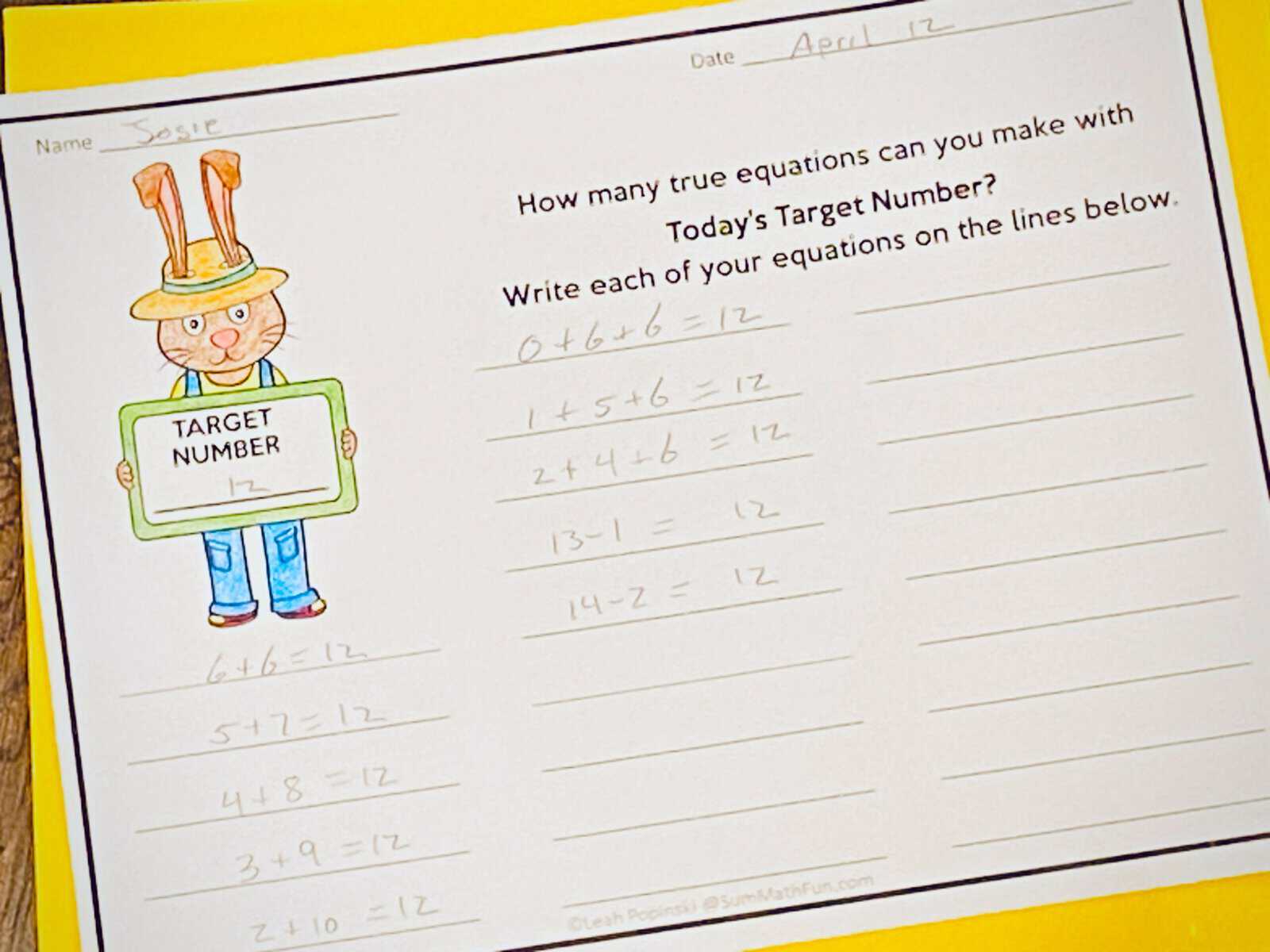
Simple. Fun. Challenging. This is a great time-filler and also perfect for early finishers.
Suggestions for differentiation:
Use whole numbers, fractions, negative numbers, or decimal numbers based on your students’ needs.
In addition, you can provide parameters for your time-filler, such as:
- Use only addition and subtraction
- Have at least three different computations
- You may use the commutative property (2 x 7 = 14 and 7 x 2 = 14 are counted as two separate problems)
- You may NOT use the commutative property to count as separate problems
- Use all four operations at least once in each equation
- An exponent must be used once in each of your equations
- At least two negative numbers must be used in each of your equations
- Use parentheses in each equation
For younger students:
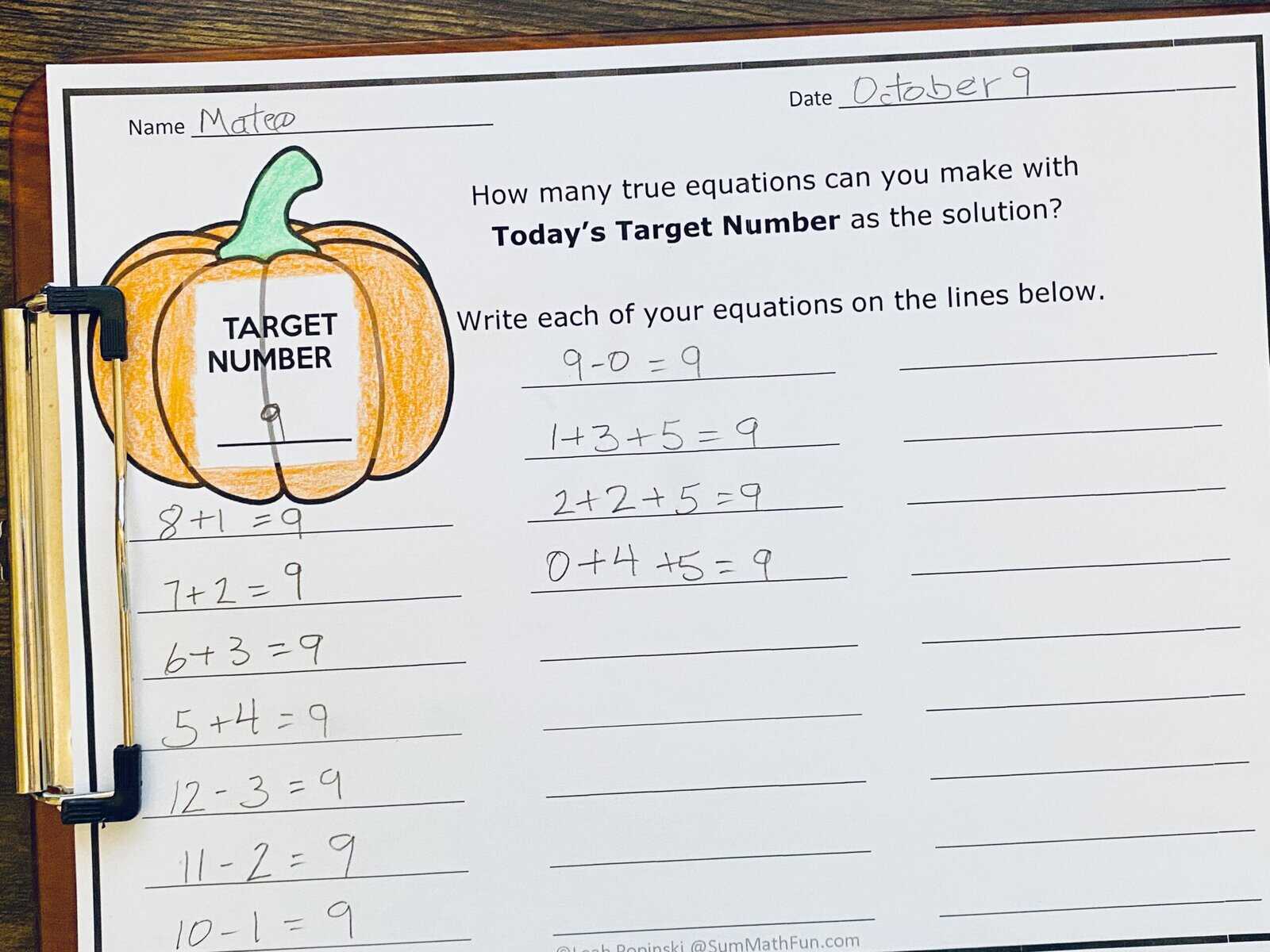
For younger students, if you’ve worked on mental math with number strings, this time-filler is the perfect opportunity to practice! A student might write 4 + 4 – 3 + 9 = 14 without parentheses for the Target Number 14. At this level, all computations are just done in the order they are presented. It’s considered a string of numbers.
👉 Here’s what this routine looks like in a real classroom in the fall season.
For older students:
For older students, you can vary this by assigning a point system in which each operation in an equation counts as one point. Then, students tally their points to find who has the most. This gets students to think outside the box and be more creative. To amplify the fun factor, have students circle each operation they used in a different color!
👉 Here’s what this routine looks like in a real classroom in the winter season.
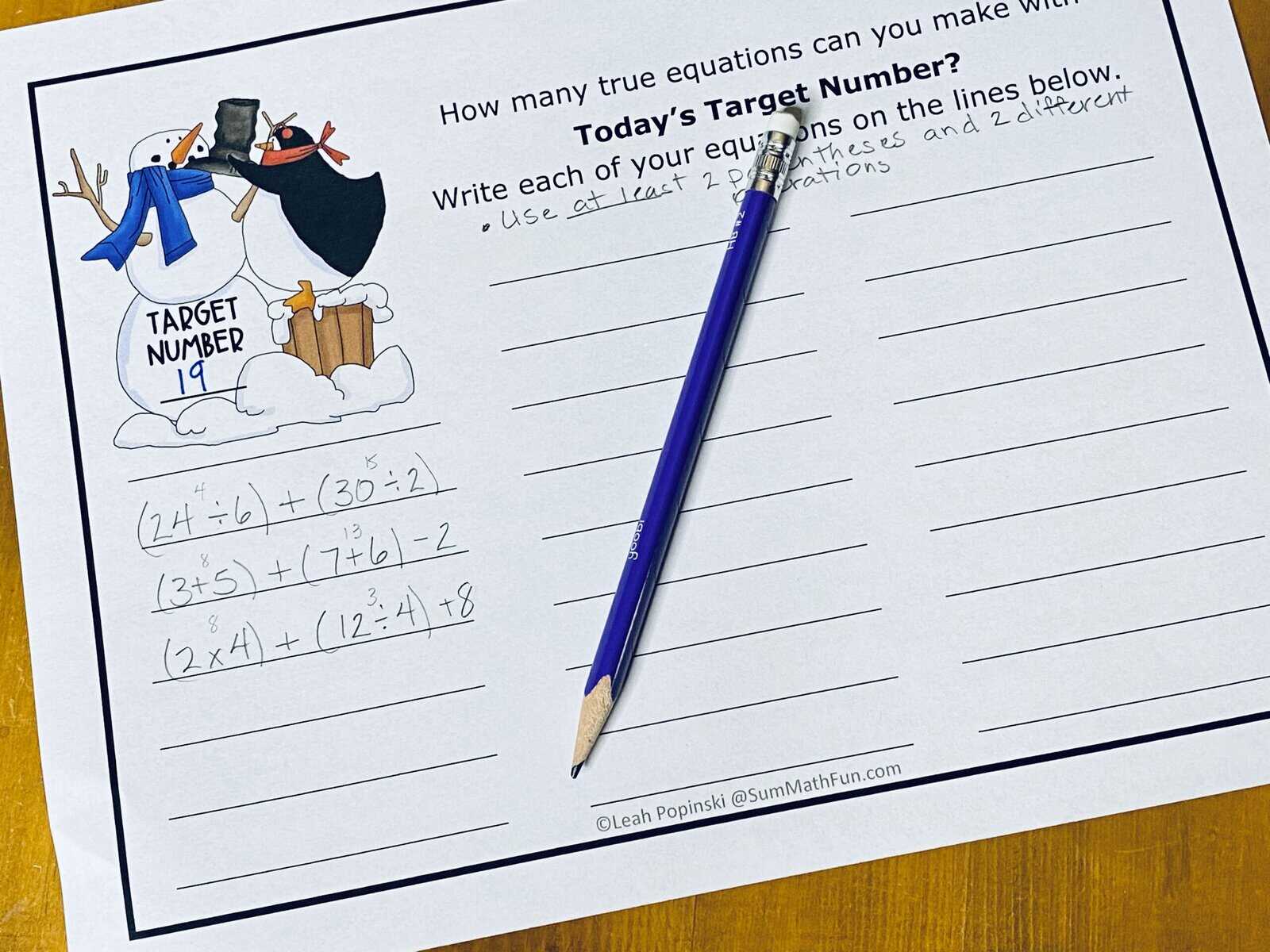
To present this to students:
After presenting the target number and any parameters you’ve set, give students 1 to 2 minutes to work independently. Then select 3 to 4 students you’ve noticed have different ways of thinking and equations. Next, ask them to share their solutions with the class so far.
This quick number talk gives those students who may be stuck in their thinking a new direction and helps them see any computation patterns they may have missed. It also gives me an opportunity to point them in the direction needed.
Then have them continue working until the timer you’ve set goes off. After that, students can share things they’ve noticed. They can switch papers or share their screens to quickly look at each other’s work (no grading, just noticing and thinking). You may choose to have students share ideas one more time with someone different, so they get a good idea of others’ thinking. Above all, your goal is to get them to think flexibly and outside their own box. 🤓
To make this routine easy to use year-round, the free printable set includes seasonal versions for fall, winter, spring, and summer — so you can keep the activity feeling fresh without changing the structure students already understand.

Each season uses the same familiar layout with themed graphics, which means:
✨ No reteaching needed
✨ Consistent expectations
✨ Easy seasonal refresh
This makes it perfect for maintaining routines while still matching the energy of the time of year.
Grab the Free Seasonal Warm-Up Set
If you’d like a routine you can pull out any time of year, this is a great one to keep in your toolbox.
💡 What’s Included
✅ 4 pages per season (Fall, Winter, Spring, Summer)
✅ Color copies for projecting or centers
✅ Black & white versions for easy printing
✅ Google Slides versions for whole-group use to project for a morning warm-up
That’s a full year of ready-to-go warm-ups using one consistent routine.
I hope this fun and rich math time-filler gives you many, many uses and saves you tons of teacher time along the way!
Thanks for reading!
And as always . . .